

Food safety requirements in the European Union are becoming more demanding. With the introduction of Regulation (EU) 2024/2895, amending Regulation (EC) No 2073/2005, food business operators must prepare for a significant change in how Listeria monocytogenes is controlled in ready-to-eat foods. The new requirements will apply from July 1st, 2026.
This regulatory update marks an important shift: food safety will no longer be assessed only at a specific point in time. Instead, businesses will need to prove that their products remain safe throughout their entire shelf life.
What is changing with this new Listeria aim?
Under the new regulation, ready-to-eat foods that can support the growth of Listeria monocytogenes will require stricter control during the full shelf life of the product.
This means that the absence of Listeria monocytogenes in 25 g must be guaranteed not only before the product leaves the food business operator’s control, but throughout the product journey: from the factory, through transport and retail, and up to domestic refrigeration.
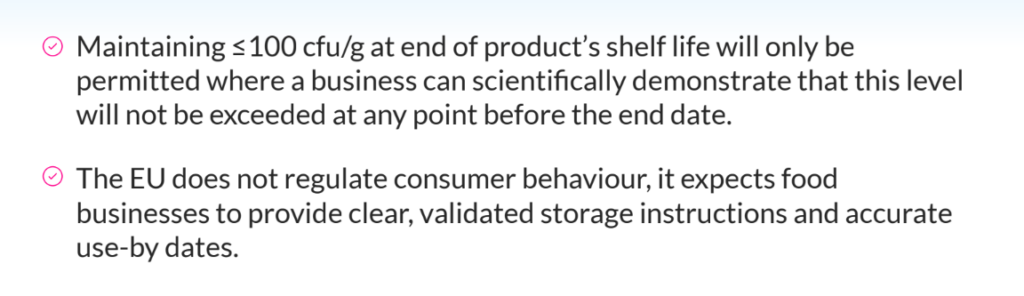
Maintaining the limit of ≤100 cfu/g at the end of the product’s shelf life will only be permitted when the business can scientifically demonstrate that this level will not be exceeded at any point before the use-by date.
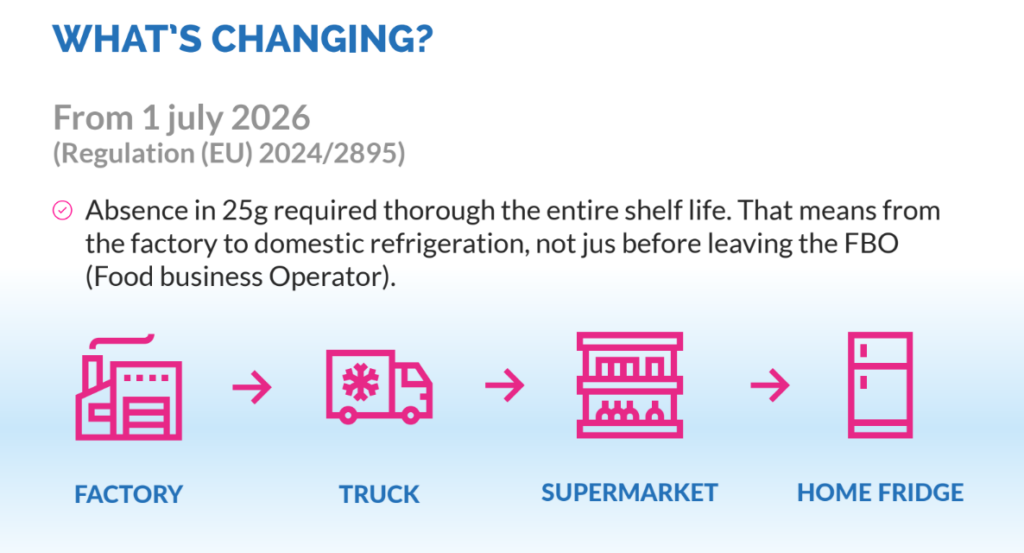
In practical terms, this moves the industry from point-in-time control to continuous safety over time.
Food safety must be proven over time
The key message behind the new regulation is clear: food safety must be demonstrated throughout the whole life of the product.
This change will require food manufacturers to review their shelf-life studies, product formulations, storage instructions, hygiene procedures, packaging systems and cold chain conditions.
Although the EU does not regulate consumer behaviour directly, food businesses are expected to provide clear, validated storage instructions and accurate use-by dates. This means companies must be able to demonstrate that their products remain safe under realistic conditions, including distribution, supermarket storage and domestic refrigeration.
Shelf-life control
Businesses will need to validate that their products remain microbiologically safe until the end of their declared shelf life. This may require additional testing, challenge studies or a review of existing validation data.
Reformulation
In some cases, product reformulation may be needed to reduce the risk of Listeria monocytogenes growth. This could involve adjusting ingredients, pH, water activity, preservatives or functional solutions while maintaining the desired taste, texture and quality.
Hygiene and environmental control
Preventing contamination during production will remain essential. Companies may need to reinforce cleaning protocols, environmental monitoring, zoning strategies and contamination control measures in sensitive production areas.
Packaging and cold chain
Packaging systems and temperature control will play a key role in maintaining product safety. The right packaging solution, combined with a validated cold chain, can help reduce microbiological risk throughout the product’s commercial life.
Why acting now matters
Although the regulation applies from July 1st, 2026, preparation should start well in advance. Validating shelf life, adapting formulations and generating scientific evidence takes time.
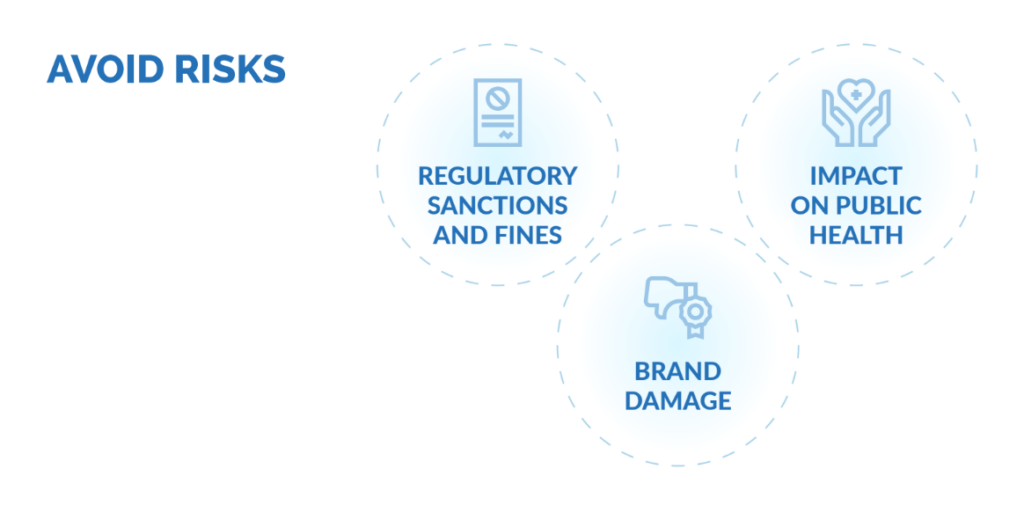
Failure to comply may expose food businesses to important risks, including regulatory sanctions, fines, product recalls, damage to brand reputation and, most importantly, potential impact on public health.
Being proactive now will allow companies to identify potential risks, adapt their products and processes, and ensure they are ready before the regulation comes into force.
How BDF Natural Ingredients can help?
At BDF Natural Ingredients, we support food manufacturers in developing solutions that help improve product stability, safety and shelf-life performance.
Our expertise and range of functional ingredients can help food businesses face the challenges introduced by the new Listeria monocytogenes regulation. From reformulation support to technical guidance, we work alongside our customers to identify the most suitable approach for each product and application.
The new regulation should not be seen only as a legal obligation. It is also an opportunity to strengthen consumer trust, protect your brand and ensure safer products throughout their entire shelf life.
Be ready before July 1st, 2026
Contact out team to learn more about how BDF solutions can help you prepare for the new Listeria regulation.